

The other day while I was writing about shadow work, it made me want to jump right back into learning more. There are times when I feel like it’s such a deep topic with so many nuances, there’s no way I can ever fully grasp it. Then there are other times when I feel like it’s as simple as knowing that shadow and light are interconnected like any other opposites. Up/down, yin/yang, night/day, and so on. And since they are interconnected, you can’t have one without the other. Which means, you can’t get rid of your shadow. Sure, you can deny those parts of yourself, but they only get shoved into hiding, you don’t actually get rid of them. And it’s those castout parts that wreak havoc, because nobody puts baby in a corner!
Since this IS a tarot and coffee post, y’all know where I’m heading… Yes, tarot is an excellent tool for exploring the shadow. Though there are certain decks that work better than others, pretty much any of them can be used to explore shadow work. “How?”, you ask. One word: Reversals.
Reversals are when you pull a card and it’s upside down. There are those, including myself, who don’t use reversals and will just turn the card to the upright position and read it that way. Reversals are just another way you can choose to use a deck, it’s a preference that each person can decide to use or not use. Each card in tarot has a light and dark aspect and a reversal can be used to bring one or the other of those light/dark aspects out. Though I’ve seen tv shows that have had a tarot reading and have depicted certain cards as being ominous and “bad”, there aren’t any bad cards in tarot. Of course that, like everything else I write, is just my opinion and others might disagree with me. They’re wrong though. JUST KIDDING. Haha. My take is that if a card does represent a not so awesome topic, like heartbreak or addiction, it’s only pointing out energy that might be out of balance. So when you’re examining a shadowy aspect of a card, you could try and figure out what is needed to bring the card back into balance.
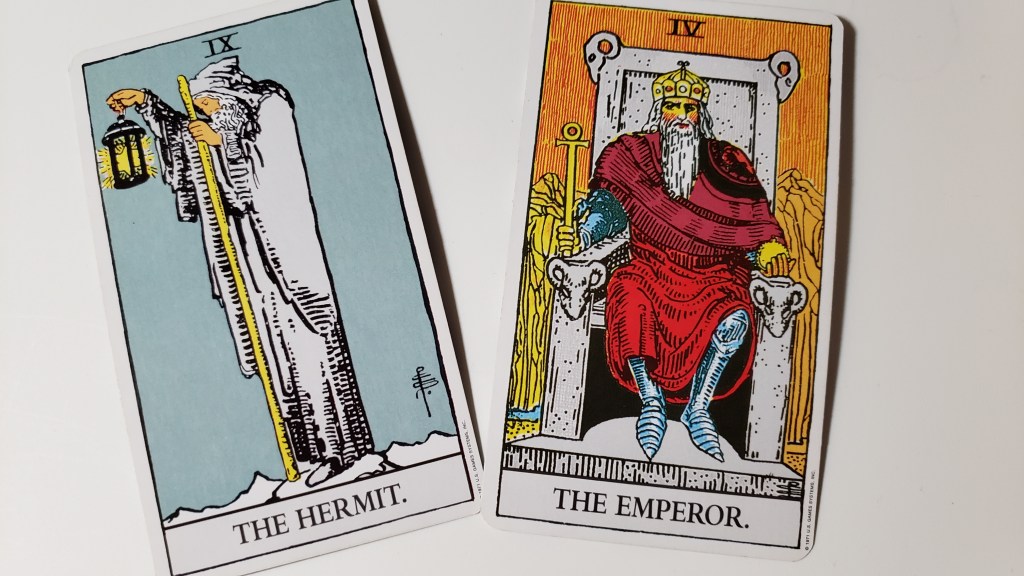
The best way to explain this is to jump right in and take a look at a couple examples. Let’s start with The Hermit. Take a look at him, he seems like he’s just wanting some “me time” and there is nothing wrong with that. Sometimes we just need to turn inward. Maybe we need to process some emotions, maybe we need to recharge, maybe we need to gather our thoughts and work through a problem. Or, perhaps it’s part of our self-care routine. Whatever the reason, it’s okay to need to take time for yourself. You might wonder how this card could have a shadow side? He seems harmless. Well, if this card gets out of balance, a person could end up self-isolating and withdrawing from family, friends, and society. Another way this card could get out of balance is if a person thinks it’s wrong to take time for themselves and as a result, they don’t. This could lead to resentment of others and taking on the persona of victim or martyr.
The Emperor is another great card that demonstrates a light and dark side. When you look at the card, it’s obvious that this is a man of power. Before I continue, this is a good opportunity to mention that cards don’t actually have a gender. They can represent any person, since we all contain a certain amount of masculine and feminine energy. My boy Carl Jung defined this energy as animus and anima. Animus is the unconscious masculine energy of a woman and anima is the unconscious feminine side of a man. There are plenty of decks that are gender fluid in their depictions of cards containing masculine or feminine energy… NOW, back to The Emperor. When this card is in balance, it represents the divine masculine. Some of the positive traits would be trustworthy leadership, maturity, structure, balance, healthy boundaries, and pretty much the sort of person you’d feel good to know is in charge. However, if the energy of this card gets out of balance, things go downhill fast. History is filled with leaders who were more in touch with the dark aspect of this card, than the light. The dark side of this card can result in a leader being power hungry, demanding, controlling, and letting a narcissistic side run rampant.
These are just two examples of how you can look at the light and dark aspects of a card. Shadow work requires you take it a step further and be honest with yourself when you evaluate where your energy might be out of balance. Let’s go back to The Hermit card and use the example of a person denying themselves alone time, which results in them being resentful of other people. Shadow work would have that person figure out where they got the belief that alone time was selfish or “bad”. We all pick up beliefs and messages from other people as we grow up. Sometimes these beliefs have been with us so long, we don’t even think to question them, when that’s exactly what we should do. Once you start sleuthing through all this baggage that you’ve picked up along the way, you get to start dismantling old belief systems and finding a more balanced way of living….. BOOM! You just completed some shadow work. Take a bow! Pat yourself on the back. Ya did good!
If you’re wanting to have a go at it yourself, two great decks to start with are The Light Seer’s Tarot or The Tarot of Curious Creatures. I like these decks because their books list the light/dark aspects of each card. Also, two books you can check out:
Shadow Dance: Liberating the Power & Creativity of Your Dark Side -by David Richo
Owning Your Own Shadow: Understanding the Dark Side of the Psyche – by Robert A. Johnson
 Sandy's Short Story Long- This is where I write.
Leave a comment