I love tarot, yet I am by no means an expert. I think that’s one of the things I love about tarot – You don’t need to be an expert and know exactly what each card means in order to get a really cool reading. Every time I use a new deck, I’m reminded of this; not knowing the meaning is a great way NOT to get distracted by “the obvious”. Yes, certain decks are familiar and comforting, but sometimes decks I don’t use often will give me an opportunity to dig a little harder. How? All you have to do is ask the cards one simple question: “You talkin’ to me?!?” Actually, that’s just fun to say…. A better question is probably: “What can these cards teach me?”
I’ve mentioned before, in past posts, that I use tarot for meditation and not prediction. Sure, I’ve dabbled in trying to use spreads for prediction, but my most powerful readings have been the ones where I used them for meditation and learning.
Each card in itself offers a lot of symbolism. Then, when you have a group of cards in a layout…all of that amplifies. And that’s when the opportunity for learning really happens.
Tarot reading is full of preferences. If you want to see this in action, randomly pick some Youtube tarot readers to watch. What you’ll find is that every reader has their own way of reading cards. For example, some people might only use an official layout. And by this, I simply mean a layout that assigns each card a reason/meaning for being in the spread. A simple example of this is a 3-card “Past, Present, Future” layout. The card on the left represents your past, the middle your present, and the card on the right your future. Some formal spreads can be quite involved and use many cards and decks. Others can be simple and use only a few cards and one deck. On the flip side, there are those who don’t use any formal spread at all. There are those who prefer to randomly draw cards and see what happens, they just go with the flow and see where it leads. I’m a free-flowing spread type of gal myself, I like to sit back and let the cards do their thing.
There was a stretch of time that I would get in my head about doing things the “correct way” and I didn’t take ownership of my preferences. For example, I’d always use a formal spread. Another example is even though I really don’t like doing reversals, I’d always begrudgingly use them. It took some time before I decided to go with what felt right for me, instead of being so worried about doing everything by the book. Now a days I only occasionally use a formal layout and when a reversed card shows up, I just turn it right side up. Maybe I’ll change my mind at some point, and that’s okay too. The main thing is to get out of your head about all of it, because that just slows you down. And it is way more fun to get the party started and see what tea your cards got for you.
I have carved out a little space in my home that I only use for meditating with my tarot decks. I find reading my cards in this little spot helps keep me in the right frame of mind. Also, by giving them their own space, I can leave my layouts out and instead of putting all the cards away, sometimes I’ll leave them out for as long as I want. At this very moment, I have a spread that has been laying there for a few days. This way I can continue thinking about any theme/story the cards presented me with. I’ve tried taking pictures of a spread and then putting the cards up, figuring that if I ever wanted to look at the cards again, I could just look at the picture. That just didn’t work for me, because looking at a picture of my spread just didn’t give me the same feels as sitting in front of the physical-real-life-cards does. Now I know… the moment I put the cards away, I’m done with that meditation and ready to put it to rest.
Here’s a useful tip I learned: In my reading area I keep some glasses, a journal, and a pen…So my lazy arse doesn’t have to get up and go find them. One of the wisest things in life that I’ve learned: I say I’ll remember the thoughts in my head, but 90% of the time my thoughts will flitter off and away. AND, if I have to get up from some carved out “me time”, I’ll get distracted by something my kids, dogs, or my own brain says to me. So, it’s just much easier to keep anything I might need in my little area.
Once my cards are all laid out, I take a moment to meditate and clear my thoughts. After that, I usually start with reading what the deck’s author of the decks have to say about the cards in the layout. I drink my coffee and pursue the deck guides; if any meanings stick out to me, I jot those down in my journal. Some might think that reading the meanings is an ending point, and for some it can be. However, if you ended it there, you’d miss all the sleuthy fun! Because after reading the authors thoughts, I Sherlock the hell out of the spread.
“Huh?”, you ask. Good question!
I didn’t learn until recently that it was Carl G. Jung who came up with the concept of synchronicity, using it “to describe circumstances that appear meaningfully related yet lack a causal connection.” I’m not surprised though; Jung came up with all the fun things. I love me some Jung. ANYway, I like to think that somewhere in our brain, WE KNOW what it is we need to meditate on most. Perhaps that part of our brain and the Universe have a little wink-wink and sprinkle some magic onto our spreads. OR it just happens. Either way, you’re gonna find some stuff. Patterns are going to be there; you just have to find them.
“But what sort of patterns could you possibly find in the cards?”, you inquire my way. WHOAH, another awesome question!
Because this method I’m describing is using tarot for meditating, there is no limit to what you can look for. You can decide to use only the deck and accompanying book to help with the layout’s meaning. Or you can go off in various other directions (like using the internet, other books, life experiences) and see where that rabbit hole takes you.
For starters, here’s some ideas to jump off from….
A lot of decks are based on the traditional Rider-Waite deck and are typically going to be divided into the Major Arcana and the Minor Arcana. The Major Arcana represents the big events in life. Some say it represents the Hero’s Journey and is filled with common Archetypes, representing the huge milestone of human existence. These include major themes that are impactful- Think birth/death, marriage/divorce, a new home or career. The Minor Arcana is more about the everyday goings-on of the human experience, situations that are easier to resolve and might equate to a fleeting moment in your life.
When you look at your spread, do the cards in front of you run heavy with one or the other? Could your spread theme be leaning towards major life events or minor everyday things?
Then, digging deeper…. The Minor Arcana is divided into four suits, each representing an aspect of life. Even though certain authors/artists might change the suits name, typically they still end up having the same (or similar) meanings. For example, maybe there is an artist who made a cat tarot deck, but decided to use a suit of claws, instead of swords. (I’m not saying there is, but if there isn’t one, there should be!) As for the meanings, traditionally they fall into these four groups:
Pentacles – Material, worldly, home, money, property….. Element = Earth
Cups – Emotion, the heart, connection to others…. Element = Water
Swords– Mind, Action, Intellect…. Element = Air
Wands– Inspiration, creativity, dreams, thoughts …. Element = Fire
When you look at your layout, is there any particular suit that is represented? If so, could the cards be heavily pointing to one particular area in your life?
Color is another way to pull some meaning out of a spread. When looking at your layout, is there a color that jumps out at you? There are different ways you can interpret a color meaning, one of my favorite ways is to see what chakra a color aligns. In my little meditation area, I keep a Chakra cheat sheet that shows what each Chakra’s color is. My chart also describes a Chakra’s spiritual and physical aspects, as well as defining what it means when it’s in or out of balance. For example, what if you notice that there is a lot of green in your spread… From my little cheat sheet, I can see that green is the color of the Heart Chakra and it relates to our ability to love, forgive, and have compassion. When in balance, there is unconditional love, but out of balance can result in jealousy.
Suits, colors, numbers (numerology), symbols, and probably tons of other aspects can all help to sleuth out a pattern and story. Just remember, whichever direction you decide to sleuth, make sure you’re writing down your findings, because at some point you will see a pattern start to emerge. And it’s with the pattern that a story will develop and it’s from this story the cards provide you a topic to meditate with. Don’t believe me? Okay, challenge accepted! I’m going to take ya as my ride-along so that you can see an example of all of the above.
As mentioned, I love to use more than one deck. For this spread I’m using:
Everyday Tarot – by Brigit Esselmont (Author), Eleanor Grosch (Illustrator)
The Wild Unknown Tarot – by Kim Krans
Messages From Your Animal Spirit Guides Oracle Cards – Steven D. Farmer
Crystal Ball Pocket Oracle – Athene Noctua
This deck combination is a mixture of some of my new or rarely used decks. The first thing I did after shuffling and having the cards pop out to form a spread, I read the accompanying guidebooks meanings that the authors attributed to each card. (The Everyday Tarot and the Wild Unknown Tarot are both based off of the traditional Rider-Waite deck, so I kind of had an idea of what to expect.)
Don’t worry if after reading all the guidebooks you’re still not seeing anything, I usually don’t see anything either. And this spread was no different. I didn’t readily see any connection and it seemed as if the cards weren’t coming together at all. This is when I settle myself in front of my altar for the first of many meditations. Small meditation breaks are key! Sometimes you really need this brain palate cleanser. I know I always do.
After my meditation break, where I did my best to clear my thoughts, I opened my eyes and returned to the layout. That’s when I started doing my best impersonation of Sherlock.
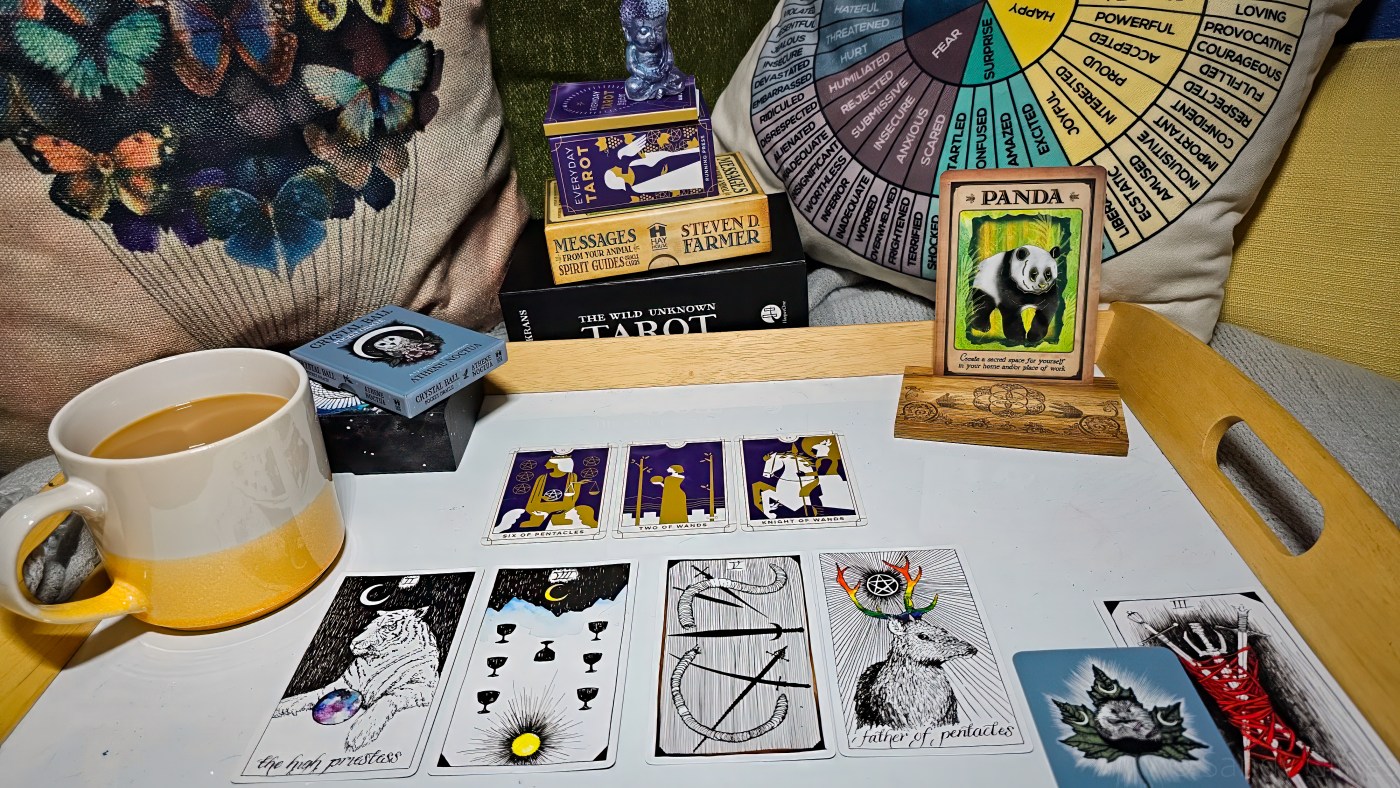
The layout I’m going to talk about is the one pictured at the top of this blog. That first row of three cards seems to me like an outline for success. These three cards are from the Everyday Tarot deck. The impressions that came to me, stripped down and simplistic, is that the meaning of the first card is about abundance (both in and out), the next card has to do with planning, and the final card in that row of three cards is about charging into action.
However, it seemed to me like they were not the major players of the story. When looking at the cards, it’s that next row of four cards that seem to really stick out. Yeah, they’re bigger, but more importantly they’re the row of cards that contain the only Major Arcana in the layout.
I don’t use the Wild Unknown deck that often and it was while reading the definitions for the second row of cards that I remembered why. This deck’s author doesn’t shy away from being harsh. I absolutely love the author and actually own a few of her decks. This particular deck, though…. Usually hits me in the wrong way. OR, maybe it’s hitting me exactly in the right way.
In her definition of the 7 of cups (2nd card in), she speaks of illusion and deception. She also talks about facing temptation, yet not being able to judge right from wrong, up from down, and the need to remove yourself until you can see straight again. The card next to it, the third one in (with the worm cut in half) speaks of self-destruction due to selfishness, and getting lured into situations you know you should avoid. EEEK!! That’s not a pretty portrait being painted right there. I definitely had a “You talkin to me?! I know you’re not talkin’ to me!” moment after reading it. So, you know what I did?? Brain palate-cleanser!
After my short meditation, I realized that these cards might be asking if there is some self-deception going on that might be getting in the way of accomplishing some dreams? Self-deception could be a situation where we’re not being honest with ourselves, like knowing that we’re not ready for something, but doing it anyway. I have this vague memory of a fictional tv doctor having a storyline where this doctor knew they had the shakes but went into surgery anyway. Maybe I dreamed that? It doesn’t matter, it’s a good example of self-deception in a situation that the doctor really shouldn’t have been participating in!(And if that storyline doesn’t exist, it should! Shonda Rhimes, are you reading this?!). On the flip-side, impostor syndrome is another way of not being honest with ourselves. It too can cause lots of self-imposed damage.
Even though the two middle cards gave me the biggest reaction (ALWAYS pay attention to what causes a reaction in you! AND, don’t forget to write that stuff down!), they’re not alone in that row. Nope. Those two cards are sitting in between the High Priestess and the Father Of Pentacles. These are two very yin/yang energies serving as a container. The High Priestess can get quiet and successfully uses self-knowledge and intuition. In this card, the Tiger is looking towards the past…. It’s through lived experiences that we can build our self-knowledge and intuition. On the other end, it’s as if the Buck is facing the future, but also looking at ME, the reader, in the now. The Father of Pentacles looks to be calm, steady, and a leader. When looking at these four cards I noticed a fun pattern? Like literally, a fun pattern… The cut-up worm is in front of a backdrop of lines, very similar to the backdrop on the Father of Pentacles card. Then, both the High Priestess and the 7 of Cups card have their own similar backdrops. Could it be that the Yin (female) energy can help with whatever is going on with the 7 of cups? And could yang (male) energy help with whatever is going on with the five of swords? Hmmm… that’s something to think about.
I scribbled into my notebook.
Down in the bottom right corner are two cards. The Three of Swords was the card sitting at the bottom of the deck, the Wild Unknown. I like to pull a card from the bottom of a deck to help contribute towards a theme for a read. For me the 3 of Swords will always make me think of issues left over from childhood. In particular, the issues we may have experienced with parents. It also makes me think of shadow work and those parts of us that may have been pushed into the dark forgotten places. I like this version of the three of swords because much like childhood “issues” (or trauma), it’s a tangled mess. You can’t easily distinguish if it’s one piece of ribbon, or if perhaps it’s three? And that tangled mess looks to be hidden in an out of the way dark space. In contrast, there’s that fun looking card that is slightly overlapping it. That is a card from the Pocket Oracle deck. Since I accidentally cut it off in the photo, you don’t see that it says “No need to worry”. Kind of an interesting thing to be sitting on top of the three swords….. What if the message here is that you don’t need to worry about unraveling and unknotting every bit of the thread before you can start healing from the Three of Swords wound? Maybe it’s saying you don’t need to identify the exact swords that made a particular wound, maybe it’s enough just to know it originated from that mess. What if it’s a reminder that we all have shadow work at play within us? What if it is a reminder to accept all of our parts, even the messy ones? AND, what if it’s a good reminder that it’s all those parts that make us whole? And that it’s when we stop that internal fighting, that we can move forward and achieve our goals.
See what happened there?! It all started to merge together and form a story! The first row was like a story outline. But the 2nd row is all the chaos and drama that goes on, behind the scenes. It’s the story that fills the pages and makes it so you’re not sure how the story will end until that last page.
Some other things I noticed in the spread:
Tigers symbolize courage, strength and bravery. Worms can symbolize the cycle of life, renewal and regeneration. A deer (buck) can mean tenderness, tempered with strength.
The first row of cards are all looking towards the past.
All suits were represented, though none stood out to me as the main focus.
The two Major Arcana cards in that 2nd row are perfect bookends, both looking outward.
As for the Panda… that card is just cute. And a good reminder as to why I have my meditation space. Haha.
I could keep digging out more meaning or I can stop here. Already my sleuthing has provided some really great topics for me to think about this week: Is there any area in my life that I am using self-deception or not being fully honest? Is it interfering with something that I want? Does the 3 of Sword wounds contribute to this? How can I use the energy from the High Priestess and the Father of Pentacles cards to help me navigate through the situation?
It doesn’t matter how you pull out the story from the cards, just pull out the story. It’s like a therapy game. It gives me things to think about and meditate on while I walk outside or sit in front of my altar. It gives me an area in my life to concentrate on, learn about, learn from, or heal.
Using tarot decks as part of my meditation practice has been a game-changer. It’s led me on some wild quests, where the endgame was getting to know myself better. I highly recommend this sort of practice! So, if you’re ever looking for a new way to use your cards, try meditating with them!
Doooo it!! 🙂
 Sandy's Short Story Long- This is where I write.
Leave a comment