I want to insert a little reminder that tarot interpretation, even if it’s just my talking about using tarot to meditate, is subjective. I lurve me some tarot… and Jung… and shadow work. However, I am by no means an expert. My intention is to share my joy on these topics. Please feel free to correct me if I got something wrong. And now…. Onto my blog post:
Since it’s the season of ghosts, ghouls, and all things scary, I thought I’d write this post about the Devil card, one of the most seemingly ominous cards in the deck.
*Insert music of doom and unease*
Actually, instead of leaning into the evilness potential, I’d like to dispel the thought that this card is evil at all. In fact, it’s the perfect card to use when we feel out of balance. Using tarot as a meditation tool, this card provides the opportunity to delve into a bit of shadow work. It provides the opportunity to explore what in life is bedeviling us, whether consciously or unconsciously, and might be throwing us off balance.
My boo, Carl Jung (famous psychiatrist and psychoanalyst- duh), believed tarot cards to be a great tool for connecting with a person’s subconscious and provide an opportunity for personal growth. How so? Good question! One way is by using the Major Arcana to represent familiar Jungian archetypes, such as the Empress representing the Mother Archetype, the Emperor being the father archetype, and the Devil representing the shadow archetype.
Before diving into shadowy depths, since tarot is largely about the symbolism of the cards, let’s first take a look at a couple of familiar Devil tarot cards.
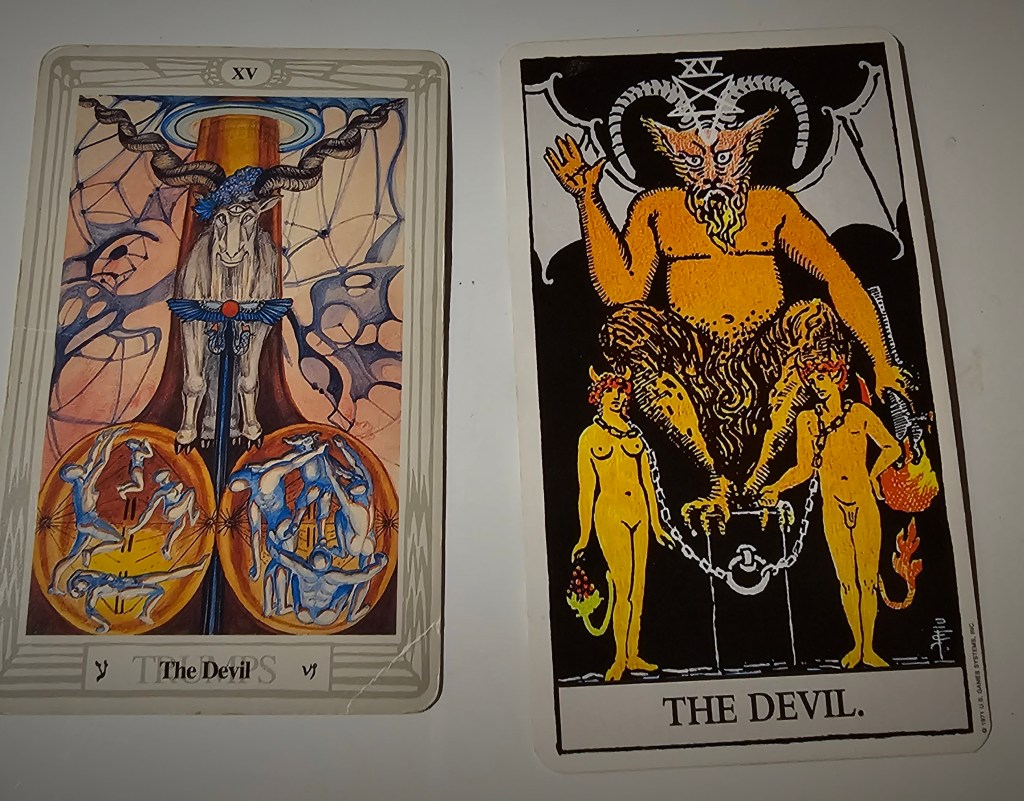
In the traditional Rider Waite deck, you might notice the horned face and think, “Yup, that’s the Devil!” However, if you allow yourself to really look at the picture, you’ll see that it depicts the Devil as half human and half goat. This is because this is a picture of Baphomet. Wikipedia says that the image of Baphomet is usually depicted as a “Sabbatic Goat” image drawn by Éliphas Lévi”….symbolization of the equilibrium of opposites”: half-human and half-animal, male and female, good and evil, etc.” Below Baphomet you see a male and female, au naturel. These two nudie beauties are seen shackled to the square pedestal Baphomet is squatting on. Though chained, it’s significant to note that the restraint is loosely fitted around their necks. So loosely fitted that if one of them had to run and take a bathroom break, they wouldn’t even have to ask for a key.
In the Thoth deck, one of my favorite decks, the artist decided to go a different direction and instead of Baphomet, they used Pan. In Greek Mythology, Pan is one of the oldest Greek gods. He is the God of Merriment and Sensuality. However, the more I read about him, I found that he’s also considered to be the god of nature, the wild, shepherds & flocks, music, and companion to nymphs. His birth story and parentage is unclear, as it changes depending on the source. Though, it does seem that his mother took one look at him and ran away. Apparently, Pan skipped the chubby baby phase of life and was born a fully matured adult male, with the torso of a man and the legs of an adult goat.
Now before you think I’m some sort of Pan fan or Baphomet expert…. I’m not. I can’t even pronounce Baphomet, so it’s a good thing I’m typing! Everything I know about Pan and Baphomet has come from tarot books and Wikipedia. Do not quiz me, I will fail. Good news is, I don’t need to fully understand either of these Gods or debate any of their good or bad sides and neither do you. All you need to know is that both versions of the card can be seen to represent our wildest selves, base instincts, and possibly our shadow parts.
Ahh, and here we are again, back to the shadow.
Shadow work is an interesting topic to delve into. Everyone has a shadow self, yet everyone’s shadow self is as unique as their fingerprint. The shadow is the part of us that we start disowning at very young age. What a person disowns about themselves is very dependent on the environment, community, culture, and upbringing they spent their early years in. Simply put, during childhood a child quickly learns what is unacceptable about themselves and in order to gain acceptance, they disown these parts of themselves. Shadow parts aren’t necessarily all the negative parts, it could be any part that is not tolerated. Sexuality, expressiveness, boldness….. These are traits that could get suppressed, if they were not traits that were acceptable in the environment the child grew up in. For example, I was raised in a religion that (at the time) didn’t believe in higher education. They looked down upon anyone who pursued a career or any sort of material possession. This view impacted my relationship with money and achieving any goals relating to pushing ahead financially… like buying a home or buying a car.
Because it’s hard to recognize our own shadow, one strategy for identifying these shadowy parts in ourselves is to pay attention to what triggers the largest emotional reaction within yourself. Whatever that is, that’s a great place to start. Shadow work is a very deep dive, if you want it to be. Since we don’t have time for that, I’d like to strip it down to this: opposites and moderation. Remember Baphomet was “symbolization of the equilibrium of opposites”. Shadow work consists of these sorts of opposites. It also consists of attributes that are from when we were young and our wildest selves. Take a moment to check in with yourself. Is there anything in life that, when you think about it, creates a big emotion for you? What is the emotion? What is the situation? Now, what is the opposite emotion? What is the opposite situation?
What if you’re feeling anger because you’re feeling overworked? The opposite of anger is joy and the opposite of work is play. Is there a shadow part that puts more value on work, than on play? This might be a good starting point to meditate on.
Anything in excess can be detrimental. ANYthing. Alcohol, yes… we all know that in excess it can be detrimental. But the same can be said about water… Yup, too much water can be fatal. Shadow work is filled with extremes. When we suppress anything and replace our lives with only the opposite, we become out of balance. And that suppressed part of ourselves becomes unruly and disruptive. By welcoming it back in, this is how we become whole again. Shadow work allows us to recalibrate our light and dark balance. The Devil card reminds us that we are not shackled, even if it seems like we are.
While you can use the Devil card by itself, another option is to draw 1 or 2 more additional cards to help you come up with an area of focus. While the Major Arcana is pretty self explanatory, if you choose to only draw from the Minor Arcana, it might be helpful to keep in mind that cups deal with emotion, pentacles deal with property/money/achievements, swords deal with intellect and your thoughts, and wands deal with travel, instinct, and communication.
And one final thought on meditation with The Devil card…. We humans are complicated beings. We humans have a kaleidoscope of emotions, thoughts, and situations. By getting to know all of our parts honestly, we can be better prepared for growth and meeting our full potential. There are no bad parts… Only out of balanced parts.
If you’d like some recommendations on further reading, I really enjoyed the following books:
Knowing Your Shadow: Becoming Intimate with All That You Are – Robert Augustus Masters PhD
Romancing the Shadow: Illuminating the Dark Side of the Soul – Connie Zweig, Steve Wolf
Embracing the Shadow: Discovering the Hidden Riches in our Relationships – David Richo
Shadow Dance – David Richo
 Sandy's Short Story Long- This is where I write.
Leave a comment